Microsoft Redmond campus
Where'd You Go BernadetteThe Microsoft Redmond campus is both a workplace and a family landmark in the story: it holds Bee Branch’s childhood memories of Microsoft, becomes the center of Elgin Branch’s technical life, and houses the team developing Samantha 2. The campus’s countdown clocks, patent cubes, and fluorescent corridors give physical form to a company organized around invention and delivery, while the eventual cancellation of Samantha 2 marks the limit of that promise.
Family Memories and Microsoft’s Visitor Center
Bee Branch’s connection to Microsoft predates Elgin’s later work on the campus. As a young child, she attended Microsoft day care, where staff loaded children into big red wagons on sunny days and pulled them around to visit their parents. Her most vivid memory is a treasure machine made by her father. A child inserted a coin and received a prize matched to their interests, such as a particular Hot Wheels car or a bottle for a baby doll. Bee remembers not understanding how it worked; later, she learns that the machine is displayed in the Visitor Center as an early example of facial-recognition technology.
The machine links a private family recollection to the company’s technical history. Elgin had been working in Los Angeles on facial recognition when Microsoft bought him out, and the device he built for children becomes a public exhibit. The campus thus preserves an early form of his work alongside the more intimate memory of a father making a machine for his daughter.
Studio West as Elgin’s Working Habitat
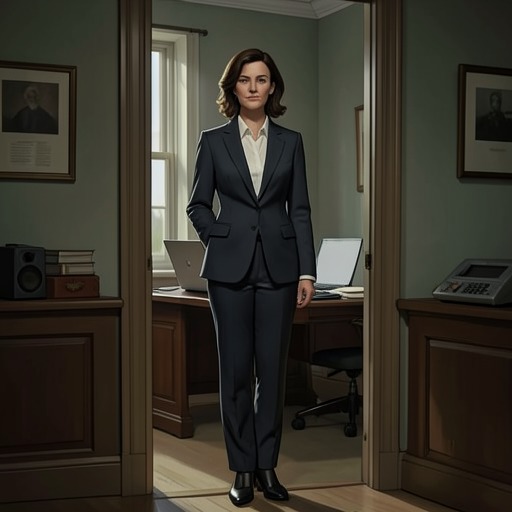
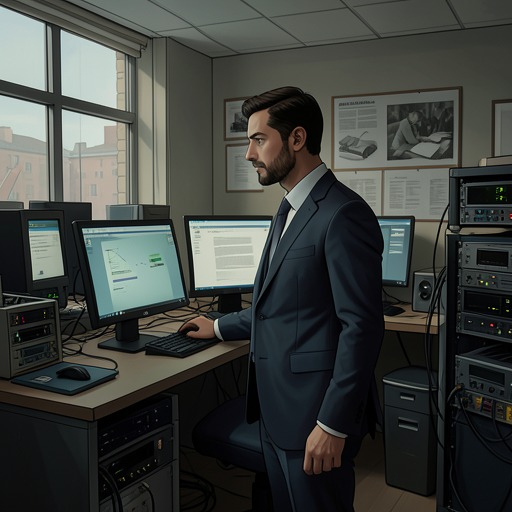
After Elgin returns to Microsoft, the newer Studio West campus provides a setting suited to his habits and interests. He is assigned to a team in Studio C, and his new role places him among the company’s most high-profile work. The environment is not presented as a conventional office routine: Elgin has a stand-up desk, hiking boots tangled at his feet, and patent cubes piled around his office. Twenty cubes sit on his windowsill alone, with others fallen to the floor, a visible accumulation of inventions and professional recognition.
The campus also accommodates his nocturnal, solitary side. Looking back on Elgin’s years in Los Angeles, the account describes him as a man in socks searching through carpeted, fluorescent-lit hallways at all hours. At Microsoft, he finds an environment reminiscent of his student all-nighters at MIT, where he threw pencils into ceiling tiles and played vintage Space Invaders with programmers. His team is based in the newest campus, whose atrium includes a sandwich shop marked by a sign advertising Boar’s Head deli meats. That ordinary workplace detail becomes a pointed marker of how thoroughly Microsoft has become Elgin’s habitat—and how far his attention has moved from his family’s life elsewhere.
A Campus Organized Around Samantha 2
The campus’s work rhythm is made conspicuous by a large digital ship clock counting down to Samantha 2’s shipment. The clock appears in the reception area, elevators, hallways, and bathrooms, turning a product deadline into a constant feature of the building. During a family visit to Elgin’s office, Bee and her mother eat takeout while sitting on inflatable exercise balls that Elgin uses instead of chairs. As Bee talks about the penguins they expect to see on their trip, the countdown continues overhead and throughout the building.
Samantha 2 is the culmination of work rooted in Elgin’s earlier experiments. At a TED presentation, he recalls testing code for a Duke research team trying to merge mind and computer. The experiments used rhesus monkeys, joysticks, and a video-screen ball; years later, after working in robotics at Microsoft, Elgin revisits the problem of helping people interact with technology. His earlier voice-activated robot, Samantha, could respond to five hundred commands, but its many moving parts made it expensive and difficult to scale. The project was canceled, prompting him to consider whether the robot itself could be removed from the equation.
Samantha 2 is presented as the next step: a system intended to help paralyzed veterans perform everyday tasks independently. Elgin says it is to ship to Walter Reed, where users can cook, watch television, work on a computer, and care for a pet. The campus is the team’s workplace, not the setting of the TED demonstration or the hospital use; its clocks and offices instead register the concentrated effort behind a product whose intended impact extends beyond Microsoft.
Cancellation and the Campus’s Meaning
The countdown’s promise is ultimately undercut by organizational change. While away in Antarctica, Elgin tells Bee that a major reorganization is underway and that, as of the tenth, Samantha 2 has been canceled; the team is being folded into games. The cancellation is reported away from the campus, but it changes the meaning of the place associated with the project. The patent cubes, high-profile team, and shipment clock have made innovation appear cumulative and inevitable. The abrupt end reveals that even a celebrated technology with a stated purpose of supporting veterans’ independence remains subject to corporate decisions about which work continues.
For Elgin, the Microsoft Redmond campus is consequently more than a backdrop. It is where Bee’s childhood memory of her father’s inventive care meets his adult identity as a celebrated developer, and where that identity becomes bound to a company’s schedules, teams, and product priorities. The contrast between the treasure machine preserved in the Visitor Center and Samantha 2’s cancellation leaves the campus holding both the durable memory of an invention and the vulnerability of a project that does not endure.